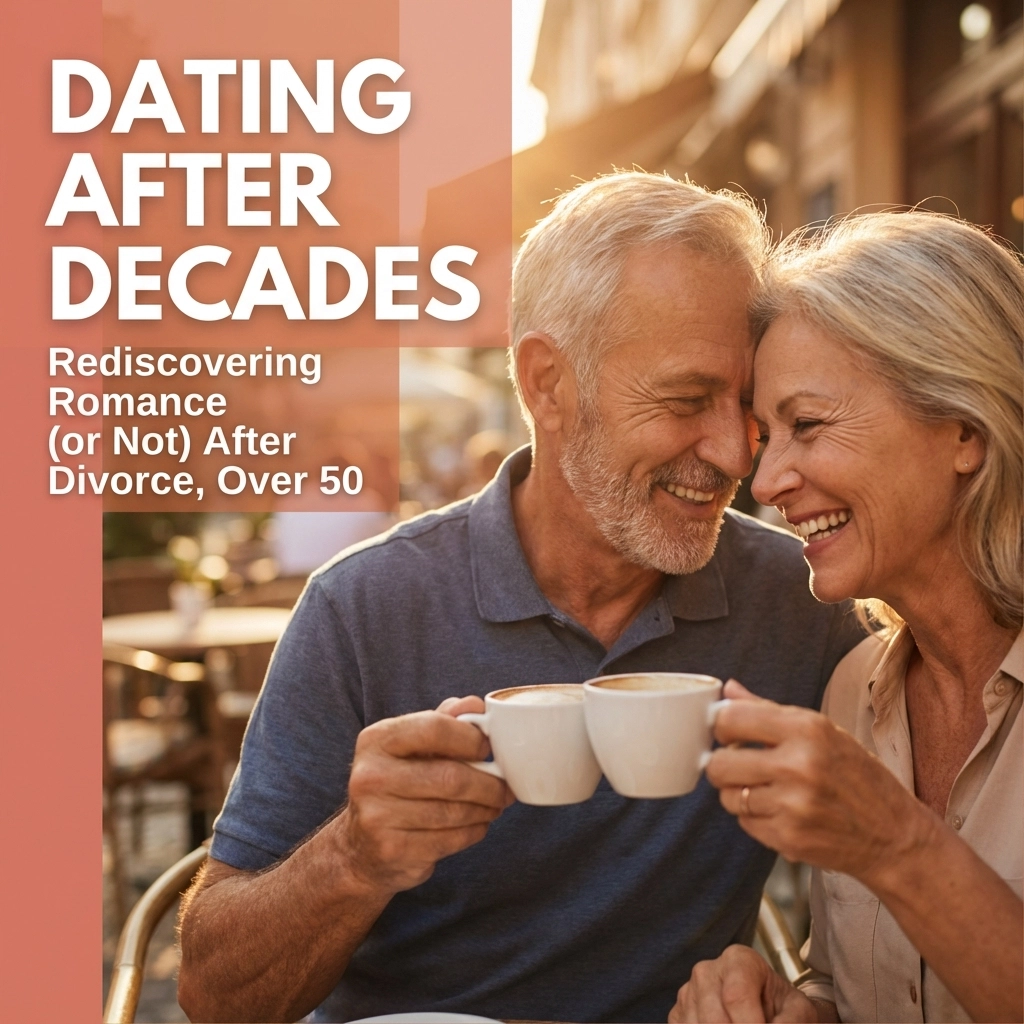
So here we are. Divorce papers signed, a new chapter unfolding, and suddenly the world expects you to have opinions about dating apps. Somewhere in the back of your mind, Frankie Goes to Hollywood is playing, and you’re wondering how on earth you got from “Relax” to “swipe right.”
Welcome to dating after divorce, over 50. Or not dating. Both are perfectly valid options, and that’s exactly what we’re going to talk about.
The Landscape Has Changed (And So Have You)
Let’s get one thing straight: dating in your 50s, 60s, or beyond is nothing like dating in your 20s. And thank goodness for that.
Back then, there was pressure. Biological clocks. Career ladders. The unspoken assumption that you needed to find “the one” and lock it down before some invisible deadline passed. There was a performance quality to the whole thing, presenting your best self, hiding your quirks, trying to fit into someone else’s picture of what a relationship should look like.
Now? The rules have shifted. Or maybe there aren’t any rules at all.
You’ve lived. You’ve loved. You’ve learned things about yourself that your 25-year-old self couldn’t have imagined. You know what you can tolerate and what you absolutely cannot. You’ve developed a finely tuned radar for nonsense. And perhaps most importantly, you’re not trying to build a life from scratch anymore, you’re deciding what to do with the one you’ve already built.
That’s a fundamentally different starting point.

The Freedom of No Longer Chasing “Forever”
Here’s something that doesn’t get talked about enough: dating after 50 can be refreshingly low-stakes if you let it be.
There’s no biological clock ticking. No pressure to have children, merge finances immediately, or impress each other’s parents (though that can still happen, let’s be honest). The urgency that defined earlier dating just… evaporates.
What remains is choice. Pure, unfiltered choice.
Some people want companionship. Someone to share a meal with, watch terrible television alongside, or travel with now that the kids have their own lives. Others are looking for romance, the butterflies, the excitement, the whole package. And some people simply want to meet new humans and see what happens, with absolutely no predetermined endpoint.
All of these are legitimate. None of them are wrong.
The freedom at this stage isn’t about finding the perfect relationship. It’s about defining what “relationship” even means to you now, and refusing to accept anyone else’s definition.
When “Not Interested” Is the Right Answer
Here’s the part that often gets glossed over in conversations about post-divorce life: some people genuinely don’t want to date again. And that’s completely fine.
Maybe you’ve spent decades in a partnership, and the idea of being on your own feels less like loneliness and more like liberation. Maybe you’ve realised that your own company is actually quite good. Maybe you’ve got friendships, family, hobbies, and a full life that doesn’t have a relationship-shaped hole in it.
Or maybe you’re just not ready. Not now. Perhaps not ever. And that’s not a failure or a sign that you’re “closing yourself off.” It’s a valid choice made by a grown adult who knows their own mind.

Society has a peculiar habit of treating singlehood as a problem to be solved, especially after divorce. As if the natural state of a human being is “paired up,” and anyone flying solo must be temporarily inconvenienced on their way back to coupledom.
That’s nonsense, of course.
Some of the happiest, most fulfilled people over 50 are those who’ve consciously chosen to invest in themselves rather than another relationship. They travel. They learn new things. They deepen friendships. They wake up on Saturday morning and do exactly what they want without consulting anyone else’s schedule.
If that sounds appealing, lean into it. There’s no prize for forcing yourself into a dating pool you don’t want to swim in.
For Those Who Are Curious
But let’s say you are interested. Let’s say the idea of meeting someone new holds a certain appeal, whether that’s mild curiosity or genuine enthusiasm.
What does that actually look like in your 50s and beyond?
For starters, it looks different than it did before. Online dating is now the default for many people, which can feel either liberating or bewildering depending on your comfort level with technology. The upside is access to people you’d never otherwise meet. The downside is… well, also access to people you’d never otherwise meet.
First dates carry different weight now. You’re not trying to figure out if this person wants kids or where they see themselves in five years career-wise. You’re trying to figure out if you actually enjoy their company. If they make you laugh. If the conversation flows or feels like pulling teeth.
And you’re working with a lifetime of experience that cuts both ways. On one hand, you’re better at reading people, setting boundaries, and knowing what you want. On the other hand, you’ve got history. We all do. Previous marriages, grown children, established routines, opinions about how the dishwasher should be loaded. Fitting another person into an already-full life requires flexibility from both sides.
The Honesty Advantage
One genuine benefit of dating at this stage? You can be more honest.
Not brutally honest in a way that frightens people off before the main course arrives. But honest about who you are, what you’re looking for, and what you’re absolutely not willing to compromise on.
In your 20s, there was often a tendency to mould yourself into what you thought someone else wanted. To hide the weird bits, downplay the strong opinions, present a slightly polished version of yourself.
Now? You’ve earned every one of those weird bits. They’re part of the package. And anyone who’s going to fit into your life needs to appreciate the actual you: not some carefully curated highlight reel.
That honesty extends to intentions as well. If you’re looking for casual companionship, say so. If you’re hoping for something more serious, that’s worth mentioning too. Playing games made sense (sort of) when everyone was young and didn’t know any better. It makes considerably less sense when you’ve got decades of experience and limited patience for nonsense.

The Timeline Is Yours
Perhaps the most important thing to remember about dating after divorce over 50 is that there’s no correct timeline.
Some people feel ready to meet someone new relatively quickly. Others need years before the thought even crosses their mind. Some dive in enthusiastically, others dip a toe in and retreat, and still others decide the whole enterprise isn’t for them.
None of these paths is superior. They’re just different.
The pressure to “get back out there” often comes from well-meaning friends and family who assume that partnering up is the goal. But you’re the only one who gets to decide what your goals actually are. You’re the one who has to live with the results.
A New Kind of Forward
Dating after divorce over 50: or choosing not to: isn’t about recreating what you had before. It’s not about finding a replacement for your previous life or proving something to anyone.
It’s about figuring out what you actually want from this next chapter. Maybe that includes romance. Maybe it includes companionship. Maybe it includes neither, and that’s perfectly fine too.
The beautiful thing about being over 50 is that you’ve already done the heavy lifting. You’ve built a career, raised children (perhaps), navigated a marriage, and come out the other side. You know who you are in a way that your younger self never could.
Whatever you decide about dating: whether you’re swiping right, meeting people through friends, or happily staying exactly where you are: you’re doing it as a fully formed human being with a lifetime of experience behind you.
And that, Max, is something worth appreciating.
For more conversations about life after 50: relationships included; visit empowerover50.com where we’re all just figuring this out together.