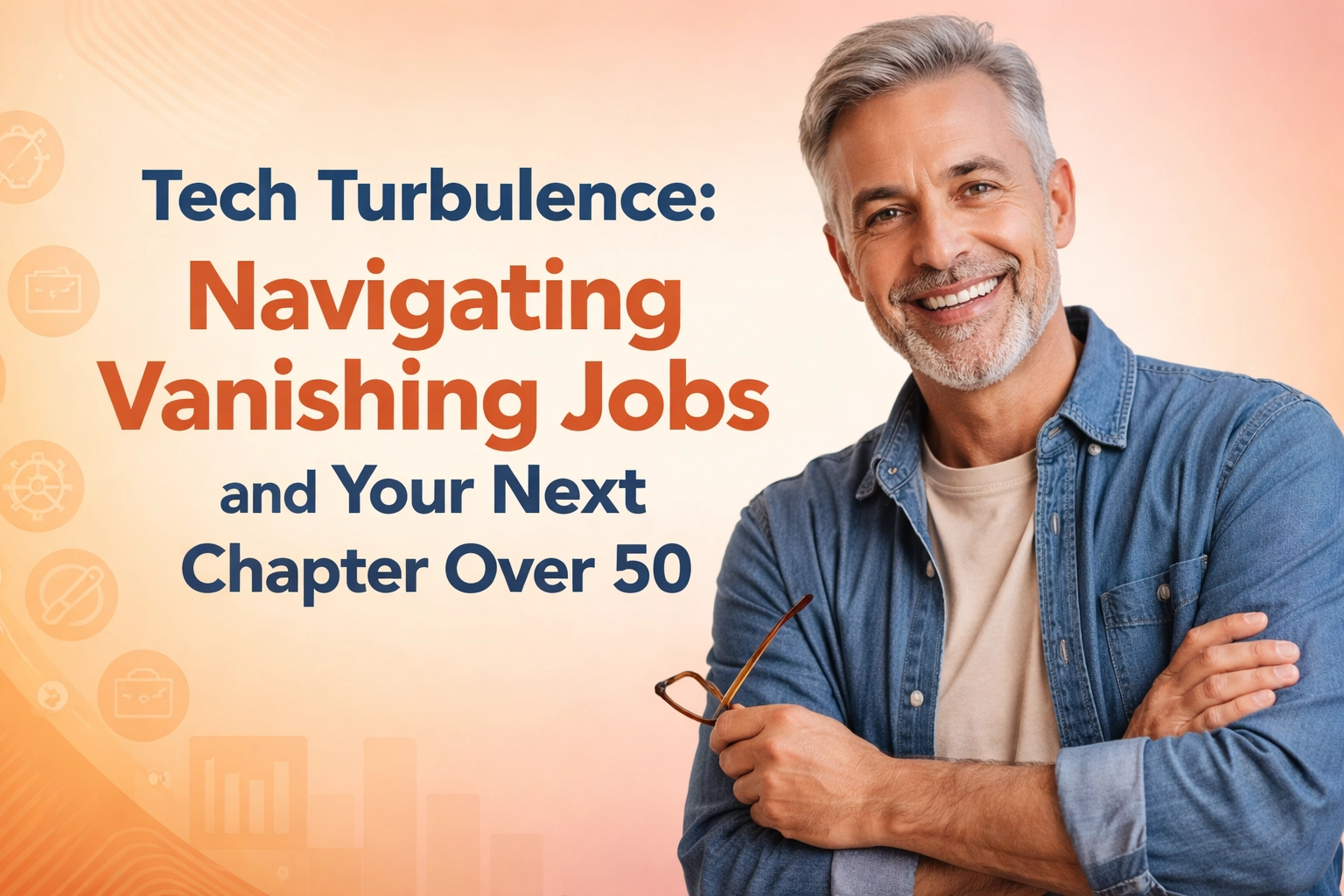
Elon Musk's moves remind us: tech jobs can vanish overnight 🚀💥. If you're over 50 facing layoffs or eyeing retirement, pivot with purpose! What's your next chapter?
The Ground Shifted. Again.
You've seen it before. The industry darling becomes yesterday's news. The "secure" department gets restructured out of existence. The email lands in your inbox at 4:47 PM on a Friday afternoon.
If you're over 50 and working in tech, or anywhere adjacent to it, you've likely felt the tremors. And lately? Those tremors have turned into full-blown earthquakes.
The tech world has always promised disruption. What they didn't mention was that sometimes you'd be the one getting disrupted.
The Numbers Don't Lie (And They're Not Pretty)
Let's get real for a moment.
Analyses of Indeed’s data suggest tech job postings are down roughly a third compared to pre-2020 levels, especially in junior roles (see Indeed Hiring Lab’s take on the “tech hiring freeze”: https://www.hiringlab.org/2025/07/30/the-us-tech-hiring-freeze-continues/). Analysts using Layoffs.fyi data estimate more than 178,000 tech employees were laid off in 2025, with projections pushing toward 200,000+ by year-end (Layoffs.fyi).
The unemployment rate has moved into the mid-4% range, the highest it’s been in several years, and many economists expect it to stay elevated through 2026 (e.g., SHRM’s 2026 outlook: https://www.shrm.org/topics-tools/news/talent-acquisition/2026-labor-market-forecast-hiring-unemployment-data).

Some are calling it the "Great Freeze." Companies aren't necessarily collapsing, they're just… waiting. Waiting to see what AI does next. Waiting to understand if they need humans at all for certain roles. And while they wait, hiring pipelines dry up and opportunities that would have existed simply don't materialise.
It's not layoffs that hurt most. It's the jobs that never get created in the first place.
The Invisible Job Market
Here's what nobody talks about at dinner parties: invisible unemployment.
That's when you're technically "between opportunities" but the opportunities themselves have evaporated. You apply. You interview. The process drags on for weeks, then quietly fizzles. The role gets "put on hold" or "restructured" or simply vanishes without explanation.
Sound familiar?
If you're nodding along, you're not alone. This isn't about your CV. This isn't about your interview skills. This is structural, a market recalibrating in real-time while we're all still standing on it.
The Musk Effect (And What It Actually Means)
Let's talk about the elephant in the room. Or rather, the rocket ship.
Elon Musk has become synonymous with bold moves and sudden pivots. Entire workforces transformed overnight. Departments axed with a tweet. The rules of corporate stability rewritten on a whim.
Now, whether you admire the man or find him exhausting (or both), the effect is undeniable: he's become a symbol of how quickly the employment landscape can shift. And if it can happen at the most visible companies in the world, it can happen anywhere.

For those of us over 50, this hits differently.
We grew up with a different contract. Work hard, stay loyal, climb the ladder. The goalposts weren't supposed to move mid-game. But here we are, and the goalposts aren't just moving: they're being replaced entirely with something we don't quite recognise.
What's Actually at Risk (And What Isn't)
Here's where it gets interesting.
The roles most exposed to AI displacement? Entry-level coders, customer service representatives, technical writers, bookkeepers: essentially, jobs built on repeatable, pattern-based digital work. Analyses from firms like McKinsey have flagged entry-level coders, customer service reps, and technical writers as roles at higher risk of automation (see McKinsey Global Institute work on generative AI and the future of work: https://www.mckinsey.com/mgi/our-research/generative-ai-and-the-future-of-work-in-america).
But here's the twist: despite widespread cuts, IDC says 90% of organisations will be impacted by IT skills shortages by 2026, with an estimated $5.5 trillion productivity hit tied to the gap (IDC press release: https://my.idc.com/getdoc.jsp?containerId=prUS52128824).
So companies are cutting jobs and struggling to find skilled workers simultaneously.
Make that make sense.
The truth is, there's a mismatch. Certain skills are becoming obsolete while others become gold dust. The question isn't whether opportunities exist: they do. The question is whether we're positioned to grab them.
The Over-50 Reality Check
Let's be honest with each other.
Age bias exists. It's illegal, it's wrong, and it's absolutely happening. Hiring managers make assumptions. Algorithms filter out experience. The phrase "culture fit" sometimes means something far less innocent.
None of this is fair. And pretending otherwise doesn't help anyone.
But here's what I've noticed: the people who navigate this successfully aren't the ones pretending they're 35. They're the ones leaning into what decades of experience actually provides: judgement, resilience, perspective, and the ability to stay standing when everything around them catches fire.
That's not nothing. That's everything.

Pivoting With Purpose (Not Panic)
I’ve lived it. The moment when everything you built suddenly feels uncertain. The sleepless nights wondering what comes next. The strange grief of losing not just a job, but an identity.
What I've learned: and what I keep relearning: is that pivots work best when they come from clarity, not desperation.
That doesn't mean having a perfect plan. It means getting honest about what matters now. What energises you? What would you do if money weren't the primary driver? What skills have you accumulated that you've never properly valued?
These aren't fluffy questions. They're the foundation of whatever comes next.
The Unexpected Upside
Here's something nobody mentions: for some of us, this disruption is actually a gift.
Strange to say, I know. But hear me out.
How many people stay in roles they've outgrown simply because leaving felt too risky? How many dreams got shelved because "now isn't the right time"?
When the external structure crumbles, it forces a reckoning. And reckonings, uncomfortable as they are, often lead somewhere better.
I've spoken with dozens of people over 50 who lost jobs they thought they needed: and found lives they actually wanted. Not immediately. Not painlessly. But eventually.
The ending of one chapter isn't the ending of the story. It's just… the ending of one chapter.
Your Next Chapter
So here we are.
The tech world is turbulent. Jobs are vanishing. AI is reshaping everything. And if you're over 50, you're navigating all of this while fighting assumptions about what you're capable of.
It's a lot. I won't pretend otherwise.
But you've been through upheaval before. Economic crashes. Industry shifts. Personal losses that made job uncertainty look trivial by comparison. You're still here. Still adapting. Still figuring it out.
That counts for something. It counts for a lot, actually.
If you're looking for a resource to help frame your thinking, I’ve put together plenty of grounded guidance for moments like this over at empowerover50.com.
I'd love to know: what does your next chapter look like?
Not the polished answer you'd give in an interview. The real one. The one you think about at 2 AM or during your morning walk. Drop a comment below or send me a note: I genuinely want to hear.
We're all navigating this together. Might as well compare notes.
Cheers,
Maxwell
For more resources and community support, visit empowerover50.com