
I was sitting with my coffee this morning, scrolling through the usual news feeds, when I got hit with a serious case of whiplash. Maybe you've felt it too – that disorienting feeling when the headlines don't match what you're actually seeing.
On one hand, you've got these massive headlines screaming about layoffs and restructurings. Corporate unease everywhere. But then you peel back one layer and look at the data specifically for mature workers, and the picture looks surprisingly resilient.
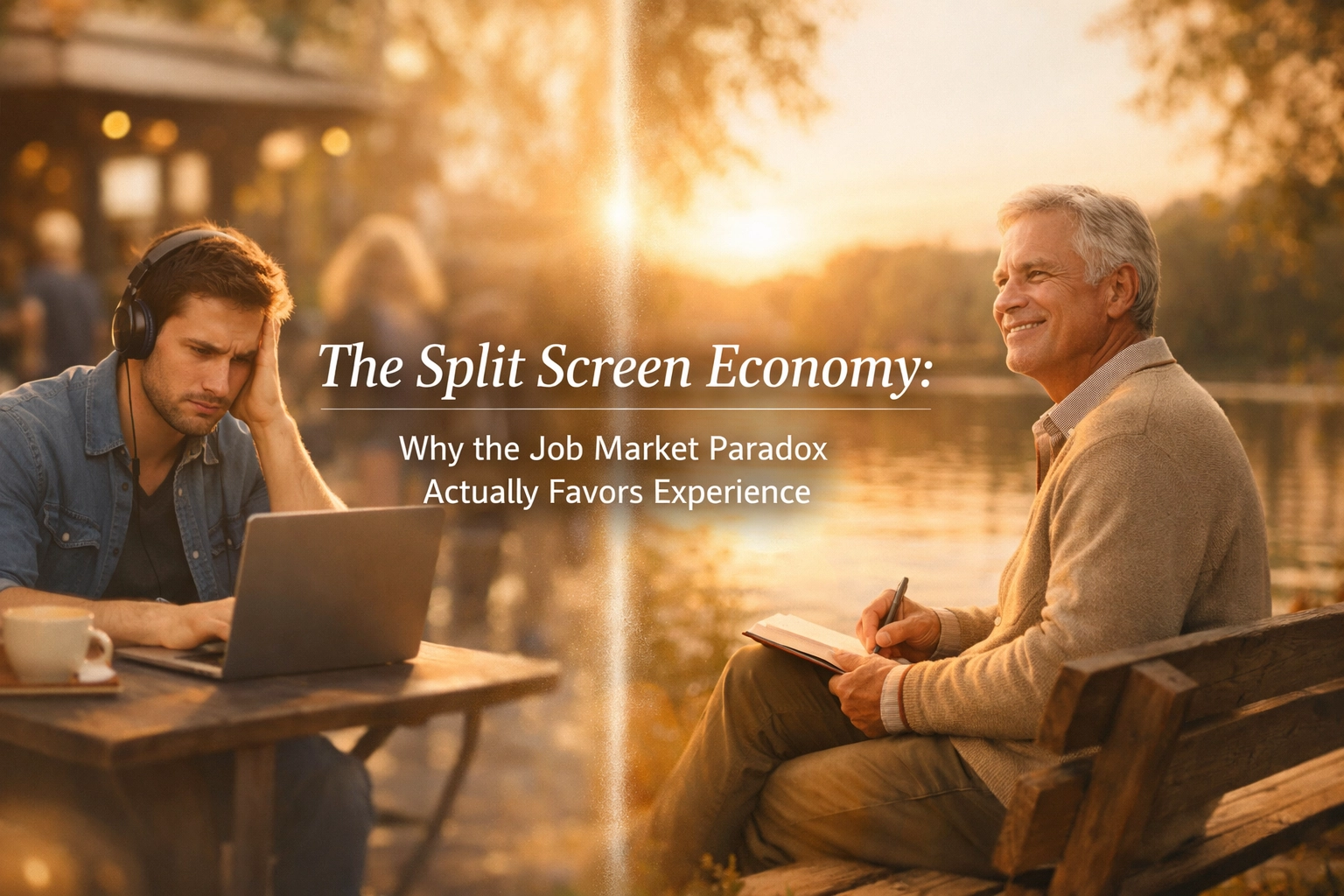
It feels like a paradox because we're living through something that doesn't fit the old economic textbooks. We're conditioned to think in binary terms – the economy is either booming or busting, either the Roaring Twenties or 2008. But right now? It's much more nuanced. It's what I'm calling a split screen economy.
The Slow Bleed Challenge
Let me start with the hard part. ABC News just released a report calling our current job market "the slow bleed." That's a visceral term, and it's unfortunately accurate.
This isn't like previous recessions where companies panicked, cut deep and fast, then stabilized. Those were acute events – a bubble bursts, a market collapses, a virus hits. Traumatic, but with a clear beginning, middle, and end.
The slow bleed is different. Companies today aren't laying people off because they're facing bankruptcy. They're laying people off to "optimize." It's not a crisis move – it's a strategy for efficiency.
This changes everything for those of us who've been in roles for 15 or 20 years. In a slow bleed market, tenure doesn't equal safety. We grew up thinking tenure was a shield – last in, first out. But in an optimization market, that can actually flip. Tenure can become a target if an algorithm decides your department is less efficient than it could be, or if your salary is higher than market average.
The slow bleed doesn't care about loyalty. It just cares about the delta between cost and output.
The Legal Shield
But here's where things get interesting. While the market is bleeding, the legal framework just handed older workers a significant tourniquet.
New York State just passed a game-changing law about disparate impact. Historically, for most age discrimination cases, you had to prove intent – that an employer consciously set out to discriminate against you because of your age. Nearly impossible unless you found a smoking gun email.
What this new law does is ban practices that have a disparate impact on workers over 40, even without intent. A company can have a policy that looks totally neutral – no mention of age at all – but if the outcome hurts older workers more, they're now liable.

The biggest target? Hiring algorithms and automated screening tools. If an algorithm prioritizes "digital natives" or keywords from recent graduates, and 90% of applicants over 50 get rejected before a human sees them, that's disparate impact. The algorithm can't hide behind efficiency anymore.
Experience caps on job postings? Now legally vulnerable. "Cultural fit" rejections based on youth-associated traits? Also in the crosshairs.
This matters beyond New York because many major corporations are based there, so their HR policies have to comply everywhere. Plus, New York is a trendsetter – other states watch, national companies get nervous, and they start auditing their algorithms to avoid litigation risk.
The Surprising Opportunity
Here's where the paradox really resolves itself, and this data genuinely surprised me. Despite all this talk of optimization, hiring for workers aged 65 and older is actually rising.
The numbers jumped from 5% to 8% of total hires. That might sound small, but in labor statistics across an entire economy, a nearly 60% increase in share is a massive signal. Their participation in the labor force is holding steady at 20%, completely contradicting the idea that older workers are just being pushed out.
Why would companies obsessed with cutting costs hire the group usually seen as more expensive?
It actually fits the slow bleed narrative perfectly. Overall job openings have dropped about 20% since 2022. In a booming market, companies hire for potential – they'll gamble on training someone young. But in a tight, uncertain market, companies stop hiring for potential and start hiring for reliability.
When you're trying to do more with less, an experienced worker who can hit the ground running becomes an efficiency asset. Training costs money. Mistakes cost money. Companies need people who can contribute on day one.
So they're not hiring older workers despite the optimization – they're hiring them because of it.
The Reliability Premium
This is what analysts are calling the "reliability premium." We're late in the economic cycle, things are rocky, and companies need steady hands. Hiring someone with 30 years of experience isn't a luxury – it's an insurance policy against chaos.

The market forces pushing toward volatility are actually creating demand for mature workers, while the legal forces are stopping companies from filtering us out with bias. The chaos is creating a protected lane for experienced workers, provided we position ourselves correctly.
What This Means for Us
Knowledge is leverage. Just knowing that disparate impact is the new standard gives you confidence. You see a job posting with a weird experience cap? That's not just annoying – it's potentially actionable.
But the real shift is in how we position ourselves. We have to shed the "historian" label – the person who knows why decisions were made in 2015. Instead, we need to be the "architect" – the person who can build what's needed tomorrow.
The slow bleed punishes tenure, but the reliability premium rewards utility. Don't position yourself as someone who needs a job – position yourself as the reliability asset that solves their immediate problem. You're the low-risk option in a high-risk world.
The Bigger Picture
Here's a provocative thought: what if optimization, this cold force we see as dehumanizing, is actually what saves the careers of older workers?
If the ultimate goal is efficiency, and algorithms eventually learn that experience equals fewer errors, faster results, and less management overhead, could the very drive for ruthless efficiency be what makes us valuable again?
What if the machines realize we're actually the most efficient part of the equation?
The market isn't closed – it's just more specific than it used to be. The days of general corporate jobs for life might be gone, but the market for specific, high-value, reliable expertise is actually heating up.
That's a much more hopeful place to be than where the headlines would have you believe.
My book "Coming Home After 50" launches February 6th and tells the story of how I've reinvented myself multiple times throughout my life, not always by choice. But this final reinvention at 56? This one I chose. Pre-order now on Amazon so you don't miss it.
For free guides and resources on this journey, visit empowerover50.com.
Sign up for the weekly newsletter here and get notified when each new post goes live.
Cheers,
Max.